
Physiognomic Function
"Outraged Nature took her hideous revenge."
Dr. Jekyll and Mr. Hyde (1920)
Points
for Reflection
John S. Robertson's Dr. Jekyll and Mr. Hyde (1920)
- Is a silent film more, or less, demanding to watch than a “talkie”? Consider this question in light of Dr. Jekyll and Mr. Hyde.
- How might colorizing this black-and-white film alter its tone?
- Does the musical accompaniment reliably signal shifts in mood and atmosphere? Does the score appear carefully crafted?
- The film opens by positing a moral binary between good and evil. Does this dualism play itself out in the film?
- At the “human repair shop” where Dr. Jekyll volunteers his time and medical expertise, does he appear to privilege one class of patient over another?
- When George Carew suggests that development of oneself requires experience, specifically a giving over of oneself to one’s impulses, how does Dr. Jekyll respond?
- Why might the filmmakers position a bedraggled street walker outside the performance hall?
- How does Dr. Jekyll’s reaction to and interaction with Miss Gina differ from his earlier encounter with Millicent?
- The narration explains that Dr. Jekyll awakens to his “baser nature” for the first time, soon after visiting the performance hall. What does this observation imply about the nature of his longstanding relationship with Millicent?
- Does Carew’s knowledge of worldly things make him a suitable parent for Millicent?
- How does Dr. Jekyll’s face shift when considering separating the good and evil within himself—prior to returning to the lab?
- Is the drug Dr. Jekyll develops a reliable agent of transformation? What does the answer suggest about the nature of good and evil?
- How does the lighting of Dr. Hyde’s face shape his character?
- Is Miss Gina equally attracted to Mr. Hyde and Dr. Jekyll?
- What response does Millicent provide to the first marriage proposal she receives?
- At what points in the film does Millicent speak, and why does this matter?
- Does the film implicitly support the claim that a woman is a necessary, positive influence in a man’s life?
- Is Mr. Hyde monogamous-minded?
- Is the method of Dr. Jekyll’s marriage proposal shaped at all by his clandestine experiences?
- Does Mr. Hyde appear invulnerable to the effects of imbibing alcohol?
- What array of physical differences do the filmmakers use to signal Mr. Hyde’s degeneracy?
- What explains Dr. Hyde’s mesmeric power over women?
- Does George Carew’s character change, or remain static?
- At what moments in the film do its creators rely on visual caricatures?
- Does the camera draw closer to, or back away from, Millicent when she’s grieving?
- Do Dr. Jekyll’s desperate, belated prayers prove effective?
- Does Mr. Hyde fascinate Millicent as he has other women?
- What prevents Mr. Hyde from assaulting Millicent?
- Why might one of the elderly men lie to Millicent about what happened to Mr. Hyde?
- Is the concluding, irreversible action taken by our protagonist supposed to be an act of atonement, or something else?
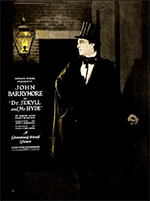
Dr Jekyll and Mr Hyde (1920)
one poster from original film release
Dr. Paul Marchbanks
pmarchba@calpoly.edu


